

Sterility and safety
Patient health and safety are our top priority. That is why we pay special attention to hygiene standards, sterilisation, and the disinfection of instruments and premises. We make every effort to ensure that every patient feels as protected as possible and confident in the safety of their treatment.
In addition to the standards required by law and the Ministry of Health, our clinic implements extra safety measures adopted from the experience of our colleagues in Western countries.
Alongside routine sterilisation measures, every three months we invite the State Sanitary and Epidemiological Service (SES) to check the health of our doctors and take surface swabs from all areas. This is done to rule out the presence of pathogenic microorganisms and to assess the quality of lighting and the cleanliness of the air in the premises. Every month we also send our instruments to the SES to verify the quality of the sterilisation process.
COVID-19 prevention measures
Mask-wearing policy
All patients in common areas (corridors, reception, etc.) must wear masks at all times. Our doctors work in protective masks and additional protective equipment — transparent SCREEN PROTECTED face shields, which are disinfected after each patient (or replaced with a disinfected one).
Minimal contact
For your safety, we schedule patient appointments in such a way that visitors do not cross paths, or that no more than two people are present at the same time in common areas.
Hand disinfection
Upon entering the clinic, every patient washes and disinfects their hands with the AHD 2000 antiseptic, which has virucidal (including against influenza A (H1N1), hepatitis B and HIV), bactericidal and fungicidal activity.
Premises disinfection
After each patient, we first carry out UV disinfection (quartz lamp treatment) of common areas, followed by ventilation. In addition, the air in the premises is further treated with UV lamps and the rooms are aired in the morning and in the evening. Door handles, lobby tables and the reception desk are also disinfected after every patient.
Temperature checks
Everyone on the clinic premises (medical staff, technical personnel and patients) undergoes a body temperature check with a non-contact thermometer.
Fewer items
We have removed all printed materials and decorative items that might attract patients’ attention and make them want to touch them. All necessary information has been digitised into QR codes.

General disinfection
Disinfection of dental treatment rooms
Dental surgeries undergo chemical disinfection before each patient. To purify the air, we use a closed-type UV bactericidal lamp. It is safe and allows people to remain in the room while it is operating.
The surfaces in the surgery (dentist’s chair, tables, shelves, lamps and walls) are treated with Mikrobac Forte solution. The equipment used by the dentist is disinfected with Bacillol, and the medical staff disinfect their hands with Sterillium.
Sterilisation of dental instruments
This is perhaps one of the most important aspects of patient protection, as all instruments come into contact with the mucous membranes and may be exposed to blood — the two main sources of bacteria.
We care about your health, so all instruments are opened in the presence of the patient, and you can verify their sterility using the sterilisation indicators placed on each instrument pack.
Disinfection
At the disinfection stage, the instruments are rinsed under running water for at least 1 minute and then treated with the Mikrobac Forte antiseptic. After that, the instruments are placed in an individual tray with a 4% Korsolex Extra disinfectant solution for 30 minutes. This solution is capable of destroying all microorganisms that have come into contact with the instruments.
Instruments with traces of blood are first soaked in a separate container with a 6% hydrogen peroxide solution.
Pre-sterilisation preparation
After disinfection, the instruments are rinsed under running water using special cleaning brushes for at least 1 minute and then soaked in an individual tray with distilled water. An exception is made for instruments with complex surfaces (for example, diamond burs), which are cleaned in an ultrasonic washer. After the instruments have been rinsed, they are dried and tested for residual blood (azopyram test) or detergent (phenolphthalein test).
Packaging
Each instrument is placed in a kraft paper sterilisation pouch with a membrane that allows steam to enter the pouch during sterilisation. The kraft pouches are equipped with a sterilisation indicator that changes colour once the cycle is complete.
Steam sterilisation
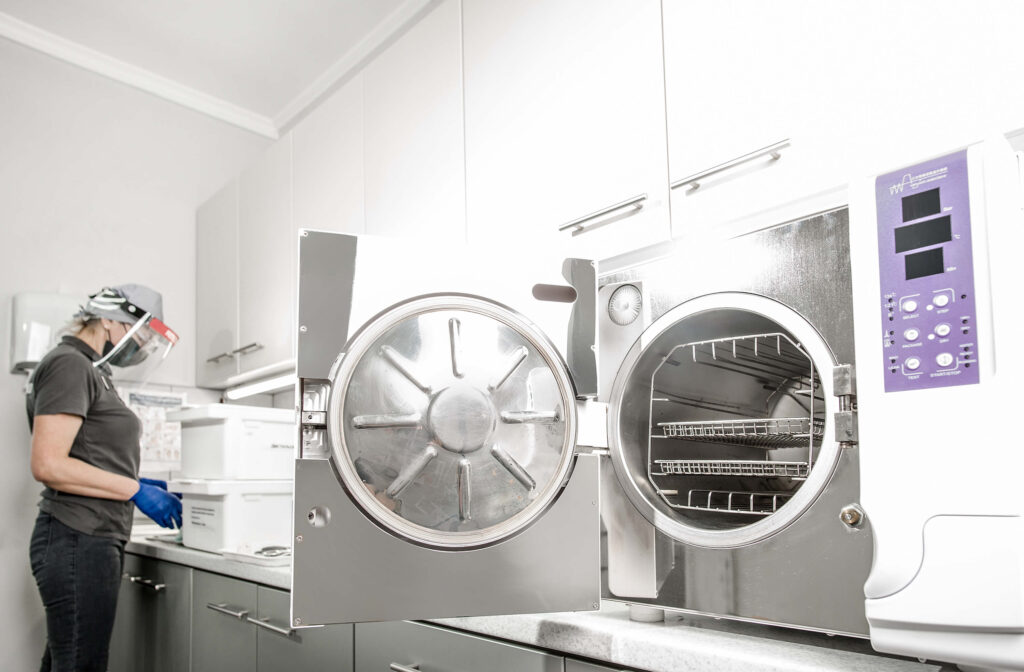
The disinfected and packaged instruments are placed in the autoclave on individual shelves so that they do not overlap. For additional protection, we place a single-use sterilisation indicator inside the autoclave.
Sterilisation takes about one hour at a temperature of 134 °C. This temperature regime is sufficient to destroy most micro-organisms within a few minutes. Once the instruments have cooled and dried, they are stored in a separate dark, dry place. Instrument sterility is maintained for up to 72 hours, after which the full sterilisation cycle is repeated, starting from the disinfection stage.