
Dental implants
Consultation with a dental surgeon, dental CT scan, implant placement and prosthetic treatment — all at one clinic
Enter your phone number, and we will call you to arrange a convenient appointment time
What is a dental implant
An implant (from the English word implant) is most commonly a structure or prosthesis surgically placed into the jawbone to replace missing teeth and restore chewing function—in other words, to support dental prosthetic treatment.
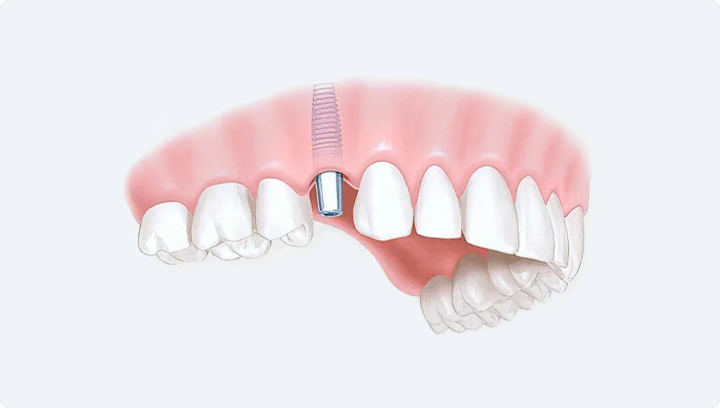
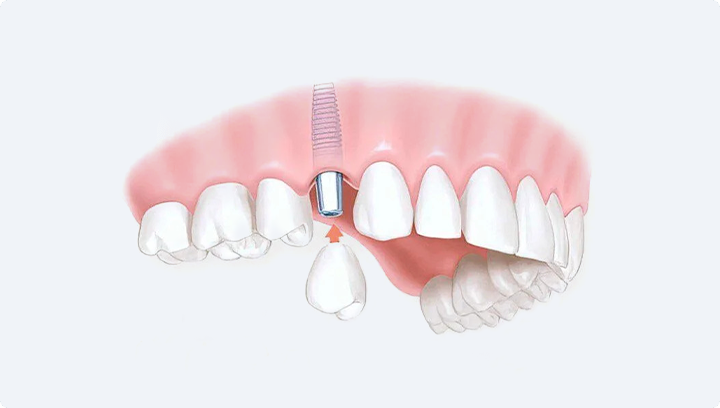
It is an artificial root made of titanium or zirconium oxide and placed in the bone of the upper or lower jaw at the site of one or more missing teeth, followed by restoration with dental crowns.
A dental implant restoration consists of five components: the implant itself, a cover screw, a healing abutment, a standard or custom abutment, and a crown.
Main stages of dental implant treatment

Examination and medical history
Medical history, oral examination and analysis of the CT scan (computed tomography) are where the process begins. The CT scan allows us to assess the size and density of the jawbone and the position of anatomical structures

Implant placement
We select the appropriate dental implant size, design a surgical guide and plan the implant procedure. The procedure is performed under local or general anaesthesia and takes approximately 20-30 minutes

Gum shaping
Depending on the implant system, a healing abutment is placed for 3-5 days after 1,5-3 months in the lower jaw and 3-6 months in the upper jaw. This shapes the gum margin around the future tooth (crown)

Digital impressions for the crown
Digital impressions are taken with a 3D scanner to ensure the future crown or dental bridge is made as accurately as possible, using a special scanning abutment (Ti-Base)

Crown fabrication
The crown is fabricated on a special high-precision CEREC milling unit and fitted the same day or the next day, depending on the selected material and the clinic's workload
Dental implants we use
reliable quality without overpaying
Reviews of our doctors
Benefits of choosing us for dental implants
Only high-quality dental implants
We use time-tested dental implants: Straumann, Nobel Biocare and Alpha Dent. All implants come with a lifetime manufacturer's warranty.Our own CT scanner
This allows us to perform detailed dental diagnostics and accurately plan surgical procedures such as dental implant placement.We do not compromise on equipment
We use modern medical equipment and instruments, making our doctors' work more comfortable and precise.Our doctors continually improve their qualifications
Our implant surgeons undergo ongoing training and internships with leading international experts in Western Europe and Asia.
Main implant placement protocols (methods)
Two-stage implant placement (with delayed loading)
This is a classic and widely used method of dental implant placement that is straightforward for both the doctor and the patient. It consists of two stages. The first stage is implant placement after preparation and planning. A dental implant is placed in the jawbone and the mucosa is sutured. After osseointegration (2-6 months, depending on the selected implant system, implant position and bone condition), the second stage is performed: gum shaping and restoration with dental crowns.
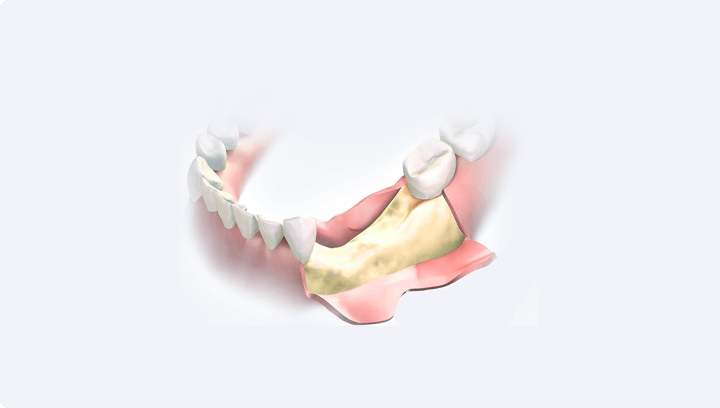
Advantage — implants integrate successfully in 95-97% of cases.
Disadvantage — the healing process and the time required to achieve the final treatment result are lengthy.
Single-stage implant placement (with immediate loading)
The implant and dental crown are placed in a single visit. The doctor places the implant and fits a temporary crown. This method has several limitations and is not suitable for everyone. It is most often used for front teeth to maintain an aesthetic appearance while the implant fully integrates. Once the implant has fully integrated (from 1,5 to 6 months, depending on the selected implant system and its position), the prosthodontist replaces the temporary crown with a permanent one.
Advantage — significant time savings and minimal intervention. Function and aesthetics are restored in the shortest possible time.
Disadvantage — a statistically higher risk of implant failure.
Basal implant placement
The method takes its name from the unconventional site where the implant is placed: the basal bone rather than the alveolar bone. Early basal implants had a very coarse, plate-like, perforated design. They were used mainly in cases of alveolar bone atrophy, but over time frequent cases of further bone loss at the implant site were observed. These implants were replaced by improved designs that more closely resemble conventional implants in both appearance and structure. Basal implant placement is used in selected clinical cases, such as edentulism, loss of alveolar bone or severe periodontitis resulting in tooth mobility.
Implant placement techniques
Elevation of the gum flap
Once the anaesthetic has taken effect, the surgeon makes an incision in the gum and prepares the implant site using special instruments. It is important to drill correctly, according to the protocol, so that the implant is placed securely while entering the bone gently. The surgeon then places the implant in the alveolar bone and fits either a cover screw or a healing abutment. The wound is then sutured. The patient is advised to apply a cold pack to the cheek over the surgical site and rest. The surgical stage takes an average of 10 to 20 minutes. According to patients, the procedure is much easier to tolerate than tooth extraction.
Immediate implant placement (sometimes with immediate loading)
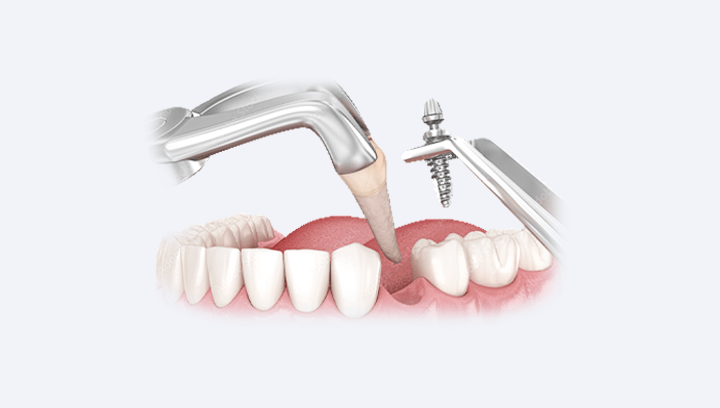
With immediate implant placement, two surgical procedures are performed during the same visit: the tooth is extracted and an implant is placed directly into the socket. In some cases, the doctor can also fit a temporary dental crown during the same visit, for example when the procedure is performed in the front-tooth area.
The main advantage is that the number of surgical procedures is reduced to one.
The main disadvantages are several contraindications and an increased risk of implant failure.
Transgingival implant placement
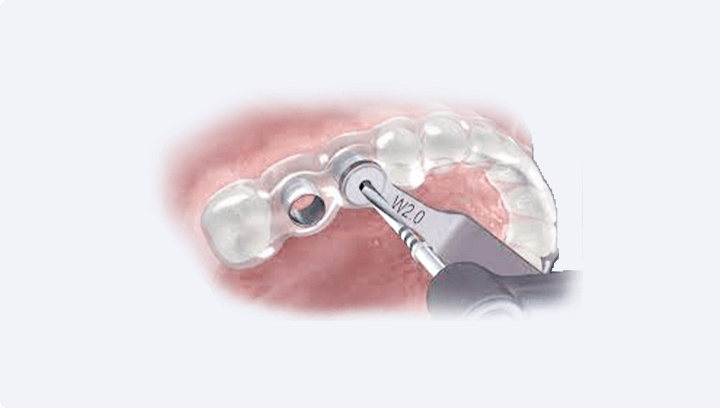
This is a minimally invasive, low-trauma method that does not require an incision or suturing of the gums. It is also described as bloodless, sutureless and non-surgical. During transgingival implant placement, no incision is made and no gum flap is raised. Instead, the implant site is created by puncturing the gum through a surgical guide or with a mucotome, a special instrument for puncturing the gum. The guide is a computer-designed model that resembles a section of the jaw and contains openings for implant placement. Its depth, position, angle and diameter are calculated precisely. This preparation makes the procedure minimally traumatic and supports a high rate of successful integration of the titanium tooth root. It is most often used when three or more adjacent teeth are missing in the same arch. The method has few contraindications.
Methods for restoring a full dental arch in complete edentulism
All-on-4 or “all on four”
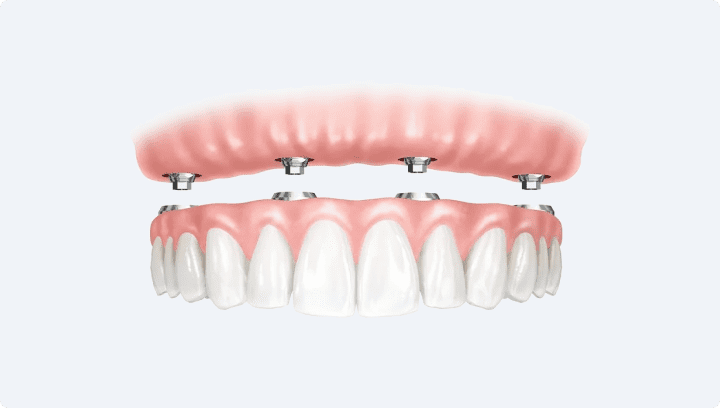
This technique is used in cases of complete or multiple tooth loss to restore the entire jaw in the shortest possible time. A fixed dental prosthesis is supported by four implants positioned evenly along the jaw; the two posterior implants are placed at an angle to avoid the maxillary sinuses. This method makes full-arch restoration possible even in cases of bone atrophy, without sinus lift surgery. The restoration is made as a single dental prosthesis with artificial gums in a healthy, natural colour. This helps conceal natural imperfections in the gum tissue and create an attractive smile line.
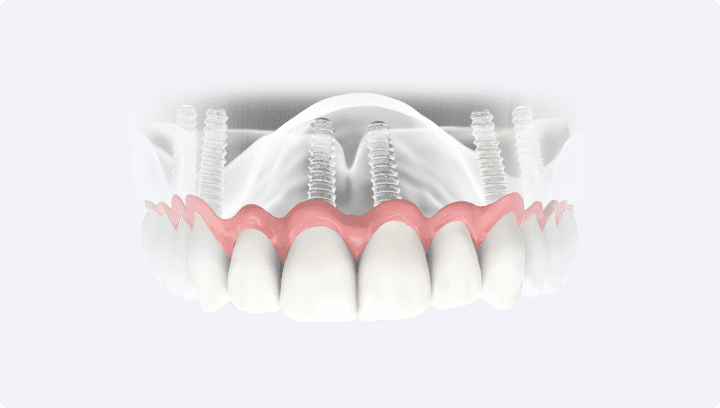
All-on-6 or “all on six”
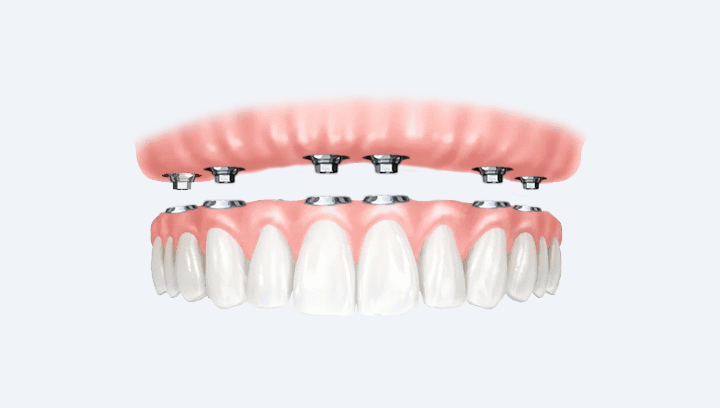
Six implants are placed vertically in the molar, incisor and canine regions. As a rule, these procedures are performed using a surgical guide, which helps reduce tissue trauma. Prosthetic treatment is possible in cases of periodontal disease and moderate to severe bone atrophy. The main difference from the All-on-4 system is the absence of cantilevers. Two additional supports are provided in the region of the sixth teeth, allowing the load on the prosthesis to be distributed evenly and reducing the risk of fracture. This also allows the load to be distributed evenly across the implants with immediate loading, improves implant stability and supports good osseointegration.
Alternative methods for restoring the dental arch
Removable dentures
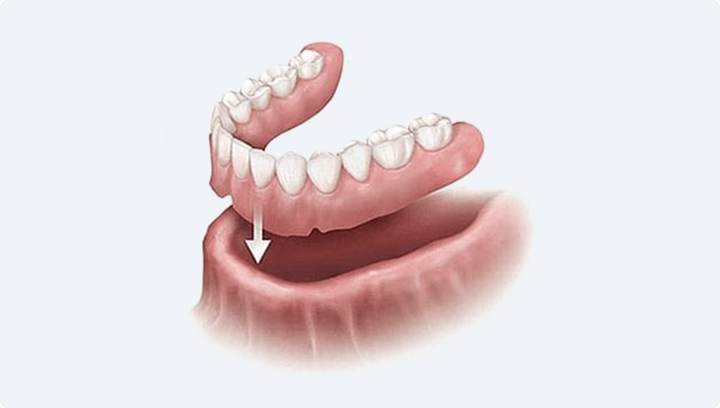
Removable dentures can replace all or multiple missing teeth. They consist of a base, a framework that imitates the palate, and a set of artificial teeth. The denture is retained by creating suction between the palate and the base. Its main disadvantage is the need for replacement every 3-5 years because the underlying bone gradually atrophies under pressure from the denture. After several years, the denture may become unstable or no longer stay in place on the jaw. Because the denture is bulky and covers the entire palate, patients may have difficulty sensing hot and cold foods and may also experience changes in speech.
Clasp dentures
The name comes from the German word “Bügel”, meaning “arch”, which forms the basis of the denture and connects the saddles of the framework that hold the standard sets of artificial teeth. These are conditionally removable dentures used for partial tooth loss; they can be removed but may also be worn continuously. The denture consists of a metal framework covered with acrylic, clasps, sometimes attachments, and dental crowns. It is securely fixed to the natural supporting teeth, so active periodontal disease must be absent. It is less bulky than a conventional plate denture and therefore offers better aesthetics. Its service life is up to 10 years.
Dental bridges
These are fixed dental restorations used when one or more teeth are missing in the same arch. A bridge requires support on both sides, either from implants or natural teeth. It resembles several dental crowns joined into a single structure. Dental bridges are made from the same materials as crowns: metal, metal-ceramic, all-ceramic or zirconia. They are fixed with a special dental cement. This type of restoration offers excellent aesthetics and can be matched to the shade of the natural teeth. The cost of replacing a missing tooth is lower. The main disadvantage for the patient is that when natural teeth are used as supports, they must be prepared and sometimes root-canal treated.
Indications for dental implant placement
One or more missing teeth
Dental defects
Problems with dentures
Contraindications to implant placement
Poor oral hygiene
Insufficient jawbone
Certain medical conditions
Dental implants – frequently asked questions (part 1)
Dental surgeon Maksym Makarenko answers common questions patients ask during an implant consultation.
- Which tests are required before dental implant placement?
- If the implant fails to integrate, who pays for replacement?
- How long do dental implants last?
- Can dental implants cause an allergic reaction?
- Can several implants be placed at the same time?
- Can an implant be placed immediately after tooth extraction?
- What complications can occur after implant placement?
- What restrictions apply after dental implant placement?
Dental implants – frequently asked questions (part 2)
Dental surgeon Maksym Makarenko answers common questions patients ask during an implant consultation.
- What is the difference between a dental implant and a post?
- From what age can dental implants be placed?
- How long do dental implants take to integrate?
- Can smokers have dental implants?
- Can dental implants be placed in patients with diabetes?
- Is dental implant placement painful?
- Implant or denture: is the higher cost worthwhile?
- Which dental implant should I choose?
Cost of dental implant placement
Megagen dental implant
from 9,000 UAH
Country of manufacture — Korea
Neodent dental implant
from 18,000 UAH
Country of manufacture — Brazil
Straumann BLT dental implant
from 24,000 UAH
Country of manufacture — Switzerland
Straumann BLX dental implant
from 28,000 UAH
Country of manufacture — Switzerland
Nobel Biocare Parallel implant
from 32,000 UAH
Country of manufacture — United States
Nobel Biocare Active implant
from 37,000 UAH
Country of manufacture — United States
What is included in the implant placement fee
CT scan, consultation and implant treatment planning, the dental implant and its placement, and the doctor's postoperative recommendations.
Warranties
The implant manufacturer provides a lifetime warranty. We provide a warranty for dental implant placement, provided that the doctor's recommendations are followed.
Locations of our clinics in Kyiv
Our dental clinics are most conveniently accessible from the following areas of Kyiv:
Clinic address: Kyiv, 25B Novomostytska Street - Vynohradar, Kurenivka, Obolon, Syrets, Minskyi Masyv.
Clinic address: Kyiv, 20 Pidvysotskoho Street - Pecherskyi District, Zvirynetska metro station.
Clinic address: Kyiv, 60/1 Yalynkova Street - Kharkivskyi Masyv, Boryspilska, Chervonyi Khutir, Vyrlytsia and Kharkivska metro stations.
Clinical cases by our surgeons
Full-mouth rehabilitation on Straumann BLX implants: All-on-6 and bridges
A patient came to us complaining of mobile bridges on the upper and lower jaws, an inability to chew properly,...
Chewing teeth restoration: Alpha Dent implants, veneers and crowns
A 62-year-old patient came to us. He was bothered by a broken bridge on the right side that made chewing...
Dental restoration: Neodent implant placement and crown prosthetics
Patient Oleksii came to us. He was concerned that he could not chew properly: in the upper jaw, on both...

Prosthetics with e.max crowns after teeth alignment
The patient came in complaining of chipped front teeth and an unaesthetic appearance of her smile. At first glance, it...
From removable dentures to Straumann implants at age 73
A 73-year-old patient came to us with a complex problem. Some teeth were missing, while others were mobile. She already...

Straumann implant placement and zirconia crowns
A patient came to us who was already tired of struggling with her “old” teeth. Pain, loose prosthetic restorations, repeated...
Book a consultation with a dental surgeon
Additional dental services
Dental crowns in 1 day
Ceramic crowns and bridges placed in a single visit and fabricated using CEREC equipment.
Dental CT scans
Dental CT scans using a modern Orthophos SL Dentsply Sirona scanner, available directly at the clinic.
Anesthesia and sedation
We provide dental treatment under general anaesthesia, nitrous oxide sedation and local anaesthesia.