

Dental caries treatment
Dental caries is a progressive process of destroying the hard tissues of a tooth — first the enamel (the superficial tissue), then the dentin (the deeper tissue) — which results in a pathological cavity that continues to advance.
Caries develops due to an unfavorable oral microbiome that enables harmful bacteria to proliferate. Caries must be treated, because the carious process does not stop on its own: it will progress, destroy the tooth toward the roots, and can spread to adjacent teeth.
Causes of dental caries
As noted above, dental caries develops in a favorable environment that promotes the growth of pathogenic bacteria. To answer the question “Why does caries occur?”, we first need to understand where these harmful bacteria come from.
Poor oral hygiene
After eating and drinking, dental plaque forms on the teeth from food and beverage residues. This plaque is biological in origin and serves as a nutrient source for bacteria, which is why it should be removed as often as possible throughout the day. Irregular or inadequate oral hygiene increases the risk of dental caries.
Lack of professional dental hygiene
Gastrointestinal diseases
When gastrointestinal disorders increase gastric acid levels, this affects lip hydration and salivary flow, leading to disruption of the acid–base balance. These conditions create a favorable environment for caries to develop as harmful bacteria proliferate. The relationship can also work in the opposite direction: caries may contribute to gastrointestinal dysfunction when caries-associated oral bacteria enter the stomach with saliva.
Injuries to the crown of the tooth
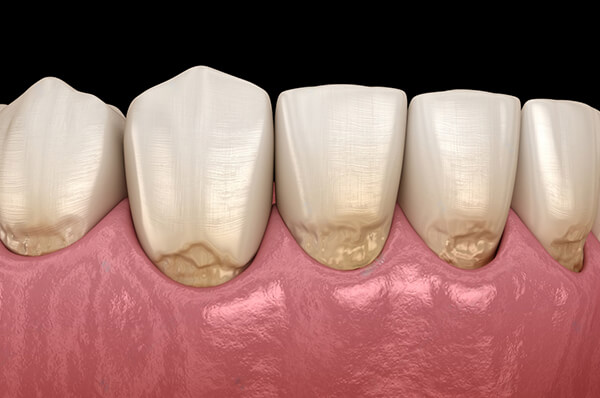
Tooth enamel acts as a protective layer and is strong, shielding teeth from immediate damage. When a tooth is traumatized, for example by a chip, or when enamel wears due to malocclusion, the enamel is lost. Beneath the enamel lies dentin, a more vulnerable tissue. When dentin is exposed and lacks enamel protection, bacteria readily attach and multiply. This also applies to the loss of a filling, which leaves the tooth exposed and unprotected.
Key symptoms of dental caries
There are four stages of caries development, and each stage has its own symptoms. Although it is difficult to self-diagnose caries at an early stage, it is sometimes possible. Let’s examine each stage and its symptomatology.
White spot on the tooth surface
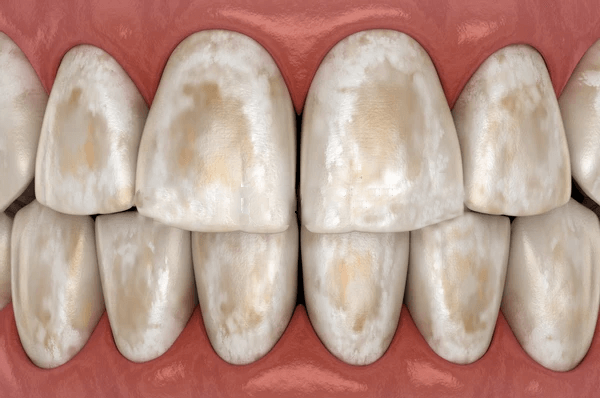
This is the initial stage of caries. It can be diagnosed during a dental examination, since a white spot is not always caries; sometimes it is simple pigmentation or a non-carious lesion (fluorosis, hypoplasia). White spots do not affect quality of life. They only indicate that a carious process has begun on the enamel surface. The process can be halted with proper oral care and certain procedures (fluoride treatment).
Brown spot
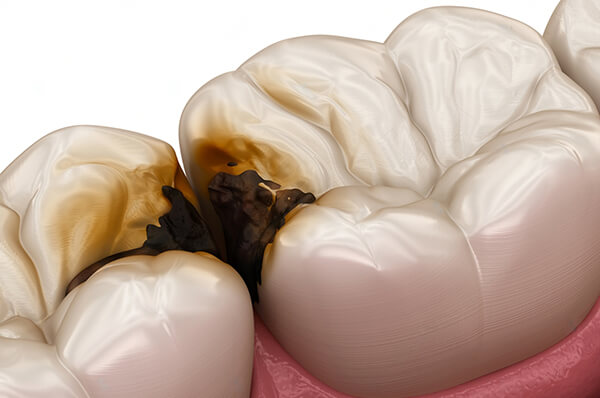
As with the first stage, when a white spot turns brown you typically feel no discomfort. The superficial caries stage indicates that the enamel has already been destroyed and the dentin will be affected next. At the first two stages, the progression of caries can be delayed with non-invasive methods. In our clinic, superficial caries is treated without drilling or filling.
Dentin caries
It is accompanied by symptoms such as heightened sensitivity to cold, heat, or sweets, unpleasant mouth odor, and short-lasting pain. These signs indicate moderate caries and require immediate treatment to prevent complications.
Peripulpal dentin caries
The final stage, known as deep caries. The lesion has passed through the dentin and approached the next layer of the tooth—the pulp. It is accompanied by prolonged sharp pain triggered by cold, heat, sweets, or food debris. The pain subsides once the stimulus is removed. Delaying treatment can lead to pulpitis and periodontitis.
Treatment methods for dental caries
Filling
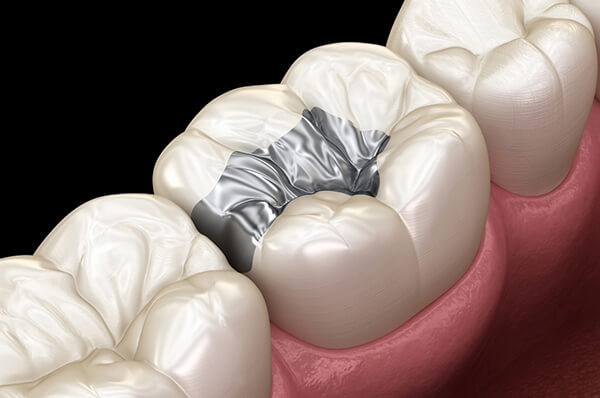
The traditional method for treating caries at all stages. Treatment is usually performed under local anesthesia. Using a dental handpiece, the dentist removes the decayed tissue, shapes the cavity to create a smooth surface for a tight and durable fit of the filling material, isolates the tooth, and seals the defect with a tooth-colored light-cured composite. The filling is then adjusted to the bite so it does not interfere, followed by finishing and polishing.
Ozone therapy
Used to treat incipient caries in the white-spot stage and is of limited effectiveness for moderate or deep caries. The procedure is completely painless, requires no drilling, and is suitable for both children and adults. Ozone is applied to the affected area using the HealOzone device (manufacturer: KaVo, Germany), which converts oxygen into ozone that inactivates pathogenic bacteria without harming healthy tooth tissues.
Atraumatic Restorative Treatment (ART)
The method is used at the initial stage of caries; it can also be applied in moderate caries, although secondary caries is relatively common. Using a hand excavator, the dentist removes the decayed tissue and then restores the tooth with a glass ionomer cement (GIC).
Fluoride treatment
A non-invasive method for treating incipient caries. Completely painless and suitable for all ages. The tooth is treated with fluoride-containing agents. Used for both treatment and prevention of caries.
Air-abrasion treatment
A method for treating incipient and moderate caries. The decayed areas are cleaned with an air-abrasion device without damaging healthy tissues. This technique can be used only in parts of the mouth that are easily accessible for treatment.
Laser treatment
Suitable for treating the first three stages of caries and is minimally invasive. The dentist removes the damaged tooth tissue with a laser, which simultaneously disinfects the healthy areas around the carious lesion.
Cost of dental treatment
Professional oral hygiene
from 2900 UAH
Air Flow
900 UAH
Tooth filling
from 2000 UAH
Gum treatment
from 1000 UAH
Root canal filling
from 1500 UAH
Endodontic treatment
from 2000 UAH
Microscope-assisted dental treatment
from 2000 UAH
Payment
There are no hidden fees. Payment is made according to the price list and the agreed treatment plan.
You can pay in cash or by card (via the POS terminal).
We provide treatment covered by insurance through your insurance company, as well as under contracts with other organizations.
Warranties
We provide a warranty for all types of dental treatment services, provided that the patient complies with all the doctor's requirements and recommendations. You can find more detailed information in the "Warranties" section.
Clinic Locations in Kyiv
The most convenient way to reach our dental clinics is from the following Kyiv districts:
To the clinic at: Kyiv, 25B Novomostytska St. — Vynohradar, Kurenivka, Obolon, Syrets, Minskyi masyv.
To the clinic at: Kyiv, 20 Pidvysotskoho St. — Pecherskyi District, Zvirynetska metro station.
To the clinic at: Kyiv, 60/1 Yalynkova St. — Kharkivskyi masyv, Boryspilska metro, Chervonyi Khutir, Vyrlytsia, Kharkivska.
Our doctors
Maksym Makarenko
Roman Mamonov
Evheniy Makarenko
Maryna Mamonova
Lydia Bulygina
Caries prevention
Prevention of any disease is always cheaper and faster than treatment. If caries is already present on a patient’s teeth, it requires immediate treatment, because complications that may arise (pulpitis, periodontitis, cyst, periostitis) if ignored are very serious and unpleasant. They require prolonged and costly treatment, are accompanied by pain, impose limits on everyday habits, and carry the risk of tooth loss. Timely detection of caries is helped by regular check-ups with your dentist twice a year.
The formation of caries can be prevented. The two main rules we learn from childhood are adequate home oral hygiene and a professional dental examination twice a year. In fact, there are more ways to promote oral health.
Adequate home oral hygiene
In addition to brushing your teeth twice a day, it is recommended to use an oral irrigator once a week, as well as dental floss and interdental brushes. Mouth rinses are not mandatory for home care and should be used only as directed by your dentist. For a healthy person, a toothbrush should have medium bristles; manual (traditional), electric, or ultrasonic brushes are all acceptable. The technique and quality of brushing are significantly more important than the type of toothbrush.
Fissure sealing
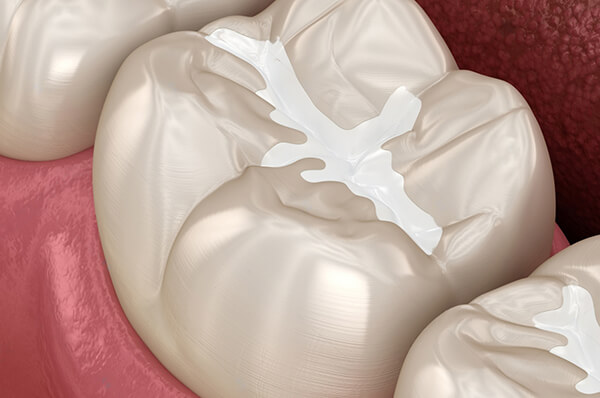
Fissures are located on the chewing surfaces of the posterior teeth as grooves, pits, and depressions. This is an ideal environment for caries and one of the most common sites of its development, since small food particles easily accumulate in these recesses and posterior teeth are hard to clean thoroughly. The sealing procedure involves closing these recesses and smoothing the surface with a clear sealant material that prevents food debris from accumulating.
Professional hygiene and check-up
Professional oral hygiene twice a year is necessary for every healthy patient to remove hard dental deposits (calculus) that contribute to caries. A dental check-up twice a year helps detect caries in time and treat it at an early stage with noninvasive or minimally invasive methods.
Fluoride treatment
Enriching the dental tissues with fluoride ions is usually indicated for younger patients. Children rarely brush skillfully and thoroughly, and even if a fluoride toothpaste is used at home, its effectiveness is often limited by brushing technique and quality. This procedure helps compensate for fluoride deficiency and remineralize the teeth.
Frequently asked questions about dental caries
How long can you leave dental caries untreated?
It is best to treat caries immediately after detection. Progression from the superficial to the deep stage can take years, whereas the transition from deep caries to pulpitis may take only a few days.
Can tooth decay spread to veneers?
Dental caries affects only biological tissues, whereas dental veneers are synthetic micro-prostheses. Caries cannot form on dental prostheses.
What should you do if decay develops under a crown?
It is best to contact the dentist who cemented (placed) the crown. Treatment is usually performed either through a small access hole in the crown or by removing the crown, treating the tooth, and recementing it. The second option is relatively risky because the crown cannot always be removed without damage; in such cases, the crown must be replaced.
Is it advisable to treat caries in wisdom teeth?
Yes, in selected cases and under specific conditions. If the third molar has erupted, is correctly positioned in the arch (does not displace other teeth), treatment access is feasible, and the tooth is restorable, therapy is reasonable. Such a tooth may later serve as an abutment for a fixed bridge or simply provide chewing function if an adjacent tooth is lost. A properly positioned third molar is not an absolute indication for extraction.