Installation of implants and bridge-like prostheses

Maksym Makarenko

Максим Макаренко Specialty: surgery, implantology, periodontology and prosthetics

Case #1. Installation of 5 implants

A woman has come to us with a complaint about the secondary adentia (absence of masticatory teeth on the lower jaw), with overloaded teeth in the frontal area.

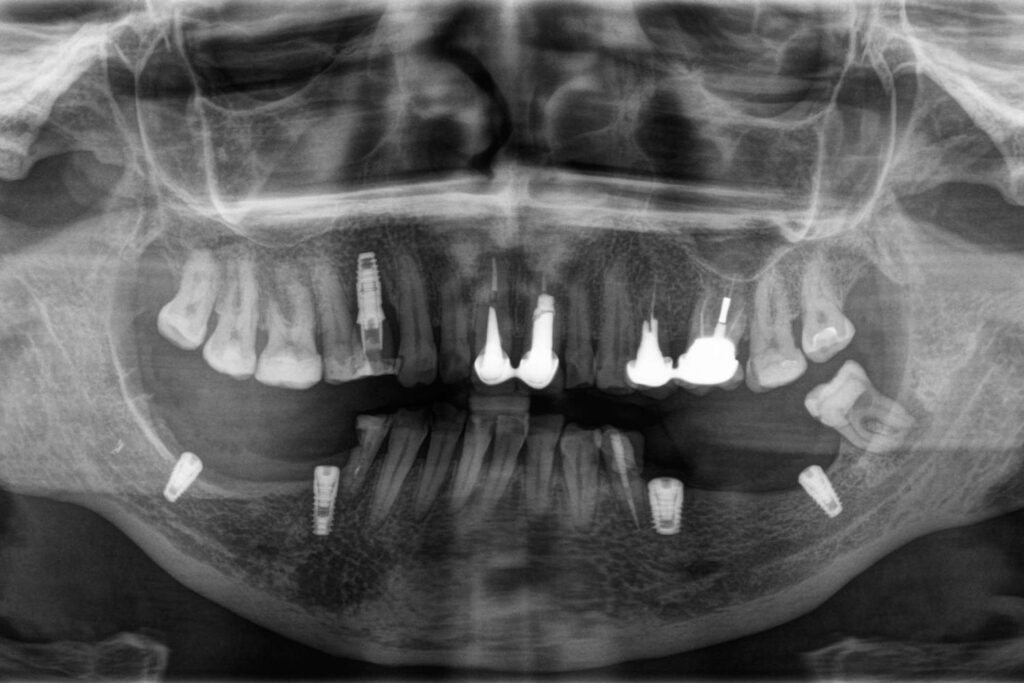
The reason was that the patient's lower jaw had several crowns on the masticatory teeth and a partial removable prosthesis, which she did not wear. As a result, these crowns were deformed and the roots of the tooth cracked. The roots cracked in the area of tooth 4.4 and 4.5, and a split appeared on the left side of tooth 3.6. The split roots of the teeth injured the gums. It became impossible to chew food.

It is important to note that the patient underwent 4 heart surgeries. Of course, she was terrified of having surgery to implant teeth because after implantation the doctor prescribes antibiotics. In addition, the patient takes drugs to thin the blood. The fear of implantation in this case was quite justified.

STAGE 1

Сomputed tomography research

After the CT scan, we decided to install implants on the right side in place of the 4th, 5th and 7th teeth with simultaneous removal of tooth debris and simultaneously place the implants on the left in place of the 6th, 7th tooth.

STAGE 2

Consultation of a cardiologist

Together with the attending cardiologist, we decided to cancel the use of drugs that thin the blood for 2 days and prescribe antibiotics 2 days before dental implants.
STAGE 3

Dental implantation

After planning the implantation, an operation was performed to implant 5 dental implants ImplantSwiss.
STAGE 4

Installation of crowns

After successful healing of implants in the jaw bone, we can move on to the final stage: the manufacture of zirconium dental crowns.

Case #2. Installation of 4 implants on the lower jaw

A woman of 50 years has come to us with a complaint about the absence of chewing teeth on her lower jaw. Previously, the patient used a removable prosthesis which affected the reduction of bone volume in the lower jaw.

After the computed tomography research we saw a reduction in bone volume and the fact that in the far parts of the mandible, the distance to the mandibular nerve is 5-6 mm. It was decided to do functional work (without bone grafting) because the task was to carry out implantation and prosthetics with minimal financial costs.

The difficulty was that the implant had to be positioned so that it passed along the anterior wall of the mandibular nerve without touching it. Such work can be done only with the help of a special CT machine and specialized programs. After planning the implantation and making the template, we were able to install the implants and got a predictably good result.

Stage 1

Computed tomography

On CT scan, we saw a decrease in bone volume and the fact that in the far parts of the mandible, the distance to the mandibular nerve is 5-6 mm. It was decided to place implants on the outside of the bone.
Stage 2

Dental implantation

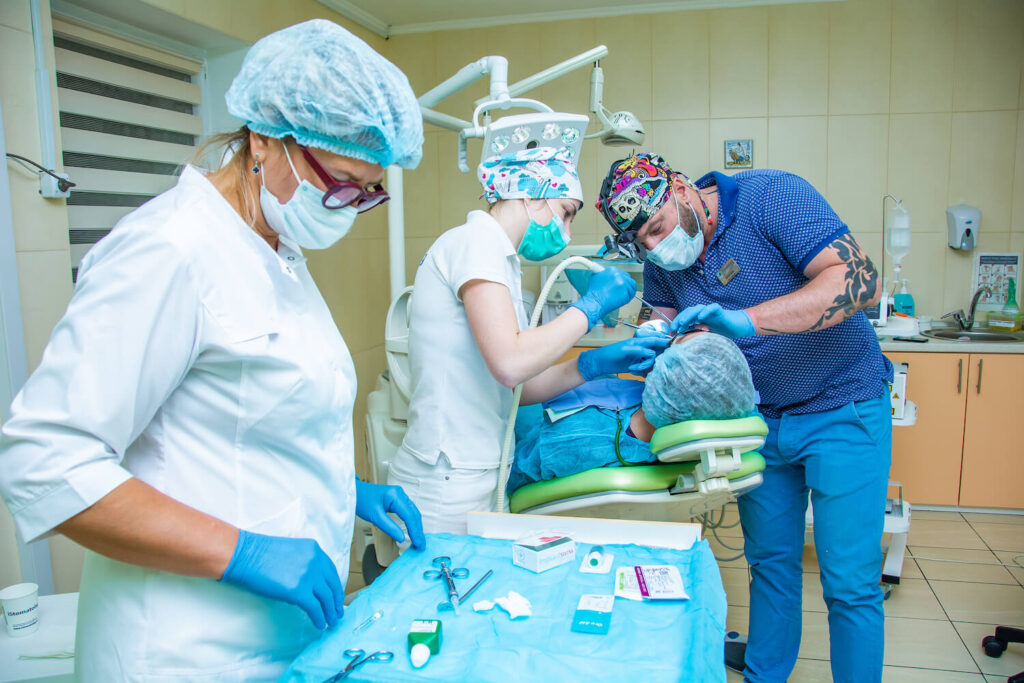
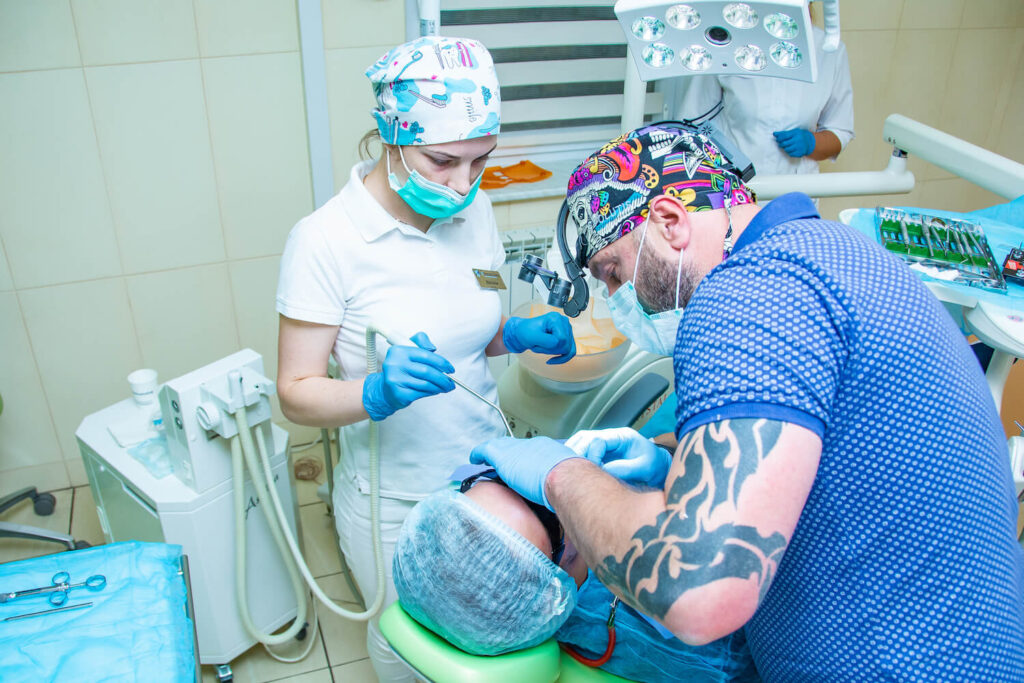
The patient is in a chair. Local anesthesia works. We installed 4 dental implants ImplantSwiss according to a preliminary made template, which allowed us to install the implants without touching the mandibular nerve.
Stage 3

Prosthesis

After successful healing of the implants in the bone (about 3 months), we will be able to move on to the final stage: the manufacture of zirconium bridges.

Case #3. Installation of 12 implants on toothless jaws

A man of 68 years has come to us with a complaint about the lack of teeth, the inability to chew food and the inability to wear removable dentures.

Antecedent history: type 2 diabetes mellitus. We have proposed to install fixed construction on implants. But this required stabilization of sugar level in blood under supervision of the treating doctor.

The installation of the 12 implants ImplantSwiss was made in one day, simultaneously with 2 upper tooth roots extraction using A-PRF clots for rapid healing.

STAGE 1

Computed tomography research

Computed tomography research helped us to plan the stages of implantation and determine the volume and type of bone, as well as size of suitable implants.
STAGE 2

Dental implantation

The patient is in a chair. Local anesthesia works. We removed the roots of the teeth, installed implants, put an A-PRF membrane, sutured.
STAGE 3

Prosthesis installation

After successful healing of the implants in the bone (about 3 months), we will be able to move on to the final stage: the manufacture of zirconium dental prosthesis.

Make an appointment with a dental surgeon