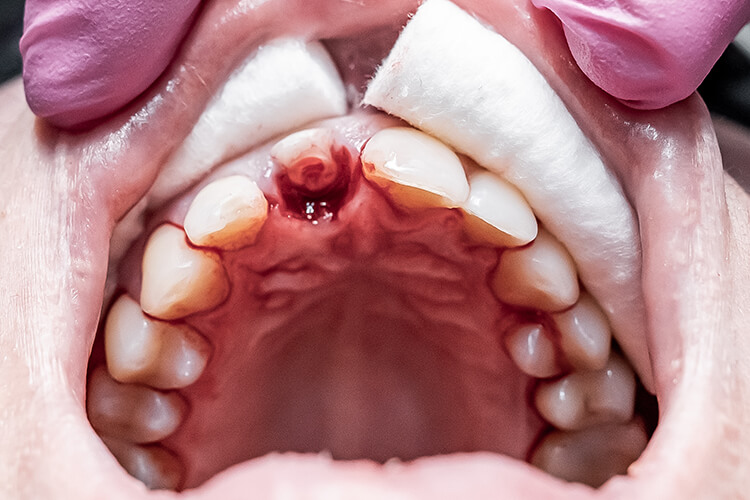
A patient came to our clinic with complaints of chipped teeth 1.2 and 2.1 and a fracture of tooth 1.1 caused by a fall after losing consciousness. She also had acute pain in the area of tooth 1.1. The patient was in despair because at the previous clinic she had been advised to have the tooth removed and an implant placed. She did not want to lose her natural tooth and was looking for a specialist who could repair the defect.
While there were no particular issues with teeth 1.2 and 2.1, tooth 1.1 was split into three parts and had an exposed neurovascular bundle. Before offering treatment options, X-ray diagnostics were required. On the image, the doctor saw that the tooth roots were intact, with a fracture of the crown portion of tooth 1.1 passing through the pulp chamber.
We proposed treating the root canals and performing a direct restoration. Direct restoration is carried out in the dental office by the doctor, using strong, reliable, and long-lasting composite (filling) materials. Indirect restoration, on the other hand, is made by a dental technician in a laboratory based on impressions of the jaws.
The patient agreed to direct restoration. The treatment took 2 visits of 1 hour each and was carried out in several stages.