


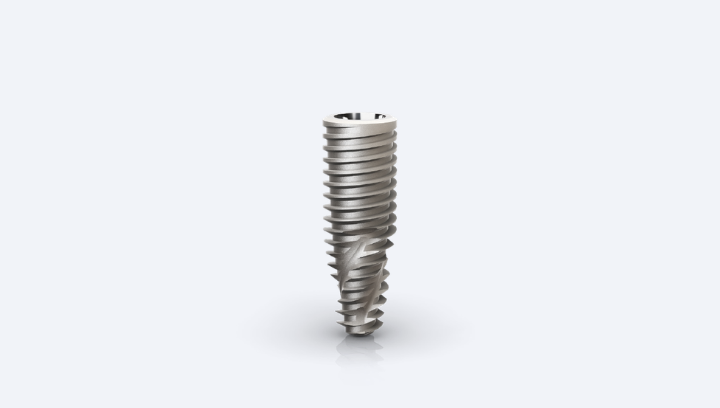
Neodent implants: history, features and models
Neodent was founded in Brazil in 1993. From the outset, the focus was on combining biological reliability with technical simplicity. In 2015, Neodent became part of Straumann Group, a Swiss holding company that brings together leading implantology brands from around the world. Following this, manufacturing, quality control and clinical protocols were integrated into an international system of standards.
Neodent implants are available in more than 90 countries. These implants occupy a position between premium solutions and affordable implant treatment while maintaining international manufacturing standards and predictable outcomes.
Features of Neodent implants
Grade 4 titanium
Neodent implants are made from commercially pure Grade 4 titanium. This material has been used in medicine for decades because of its ability to interact safely with bone tissue. It does not contain additional metals such as aluminium or vanadium, which are sometimes used to increase the rigidity of an alloy.
For the patient, this means two things. First, titanium is well accepted by the body and does not cause unwanted reactions. Second, the material is strong enough to withstand chewing forces for years. The balance between strength and biocompatibility is important because an implant must be both stable and safe for the surrounding tissues.
NeoPoros surface
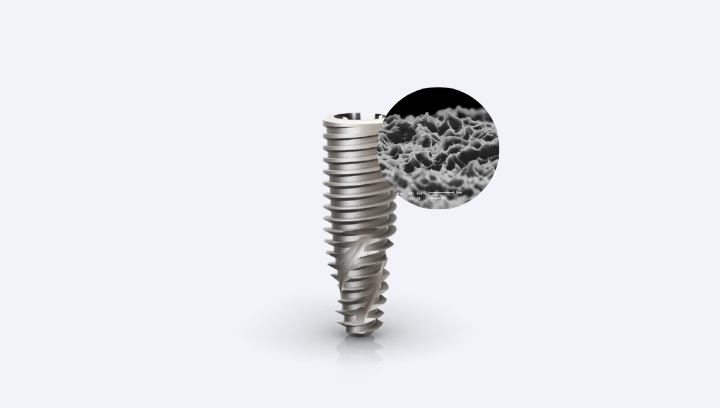
NeoPoros is a specially treated implant surface with microscopic roughness. When an implant is placed in the bone, it is important for bone cells to attach to its surface quickly and securely. The microroughness increases the contact area and creates favourable conditions for new bone formation around the implant.
For the patient, this means a stable osseointegration process in standard clinical situations. NeoPoros is used in the conventional implant protocol when the bone has sufficient volume and density and the implant is loaded after a period of complete healing.
Acqua surface
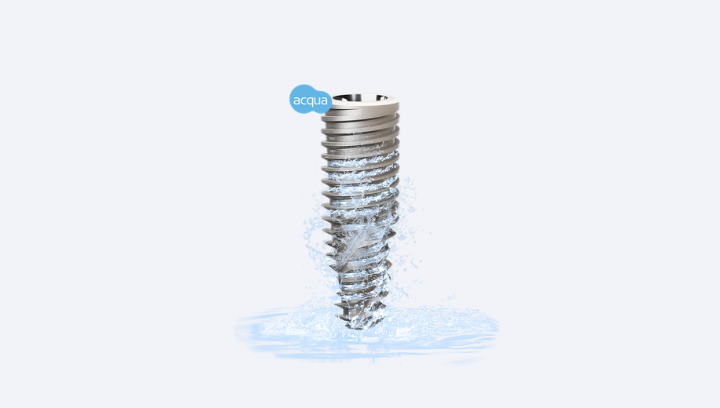
Acqua is an enhanced version of the NeoPoros surface. After the microrough structure is created, the implant undergoes additional treatment that makes its surface hydrophilic, meaning it can actively interact with blood immediately after placement.
Why is this important? The first minutes after implant placement are critical for the start of the healing process. The hydrophilic surface allows blood to spread evenly over the implant, promoting faster formation of a stable clot and the beginning of new bone formation.
For the patient, this means a more predictable initial stage of osseointegration, especially when early or immediate loading is planned or when the bone has reduced density.
Grand Morse connection
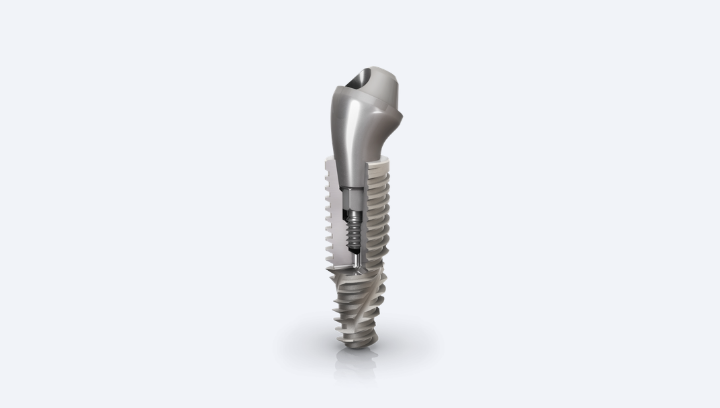
A microgap can potentially form at the connection between the implant and the abutment. If present, bacteria may enter it and, over time, affect the condition of the tissues around the implant. The Grand Morse conical connection minimises this space and reduces the risk of inflammation.
The system also uses the platform-switching principle, in which the abutment is slightly narrower than the upper part of the implant. This reduces stress on the edge of the bone and helps preserve its level over the long term.
For the patient, this means a more stable restoration, a lower risk of complications and better preservation of the tissues around the implant over the years.
Which Neodent implant to choose
The Neodent implant system includes three implant models, each designed for different clinical tasks. Below, we provide a clear comparison.
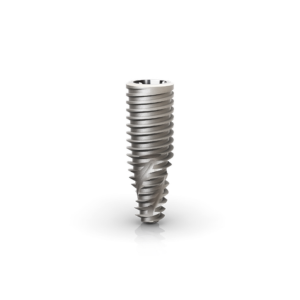
Neodent Helix
tapered body · universal geometry
Key point: a universal implant suitable for most patients. It achieves good fixation in bone of varying density.
Suitable when: one tooth, several teeth or an entire arch needs to be restored, including All-on-4 and All-on-6.
What this means for the patient
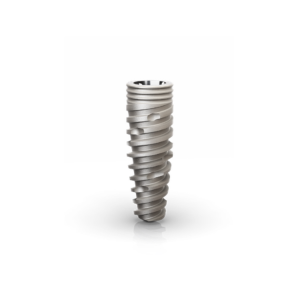
Neodent Drive
pronounced thread · focus on primary stability
Key point: an implant with a more aggressive thread that provides better fixation in soft or less dense bone.
Suitable when: the bone is soft or the anatomical conditions are compromised and stability is critically important.
What this means for the patient
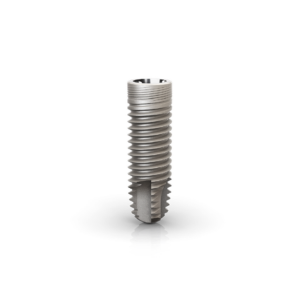
Neodent Titamax
more cylindrical body · for denser bone
Key point: a model for dense bone. It provides controlled and precise placement without excessive compression.
Suitable when: the bone is highly dense, anatomical conditions are standard and predictable primary stability is expected.
What this means for the patient
Who Neodent implants are suitable for
Neodent is an implant system that works well in a wide range of clinical situations. It is not positioned as a budget option, but it is not part of the ultra-premium segment either. It is therefore often chosen when a predictable outcome needs to be combined with a reasonable treatment budget.
The system is suitable for patients who have lost a single tooth in the posterior or anterior region and need to restore function without excessive invasiveness. Thanks to their tapered shape and stable primary fixation, the implants can be used in standard anatomical conditions without additional complications.
Neodent is also appropriate in cases of partial or complete edentulism when several implants need to be placed or full-arch prosthetic rehabilitation is required All-on-4, or All-on-6. The Grand Morse platform provides connection stability and load control, which is important when restoring an entire arch.
Patients with reduced bone density form a separate category. In such cases, models with pronounced threads can provide sufficient primary stability, expanding treatment options without excessive bone grafting.
Frequently asked questions about Neodent
Are Neodent implants high quality?
Yes. This is a modern international implant system in the Straumann Group portfolio. It is made from medical-grade Grade 4 titanium, has advanced surfaces that support osseointegration and features a stable Grand Morse conical connection.
In simple terms, this is not a case of saving on materials, but a balanced solution with a predictable outcome. In most clinical situations, Neodent can provide a reliable, long-term result without paying extra for a premium brand. When the bone conditions are suitable, it is a very sensible choice.
Neodent or Straumann: what is the difference?
The difference is not that one implant integrates and the other does not. Both systems work. The distinction lies in the materials, scientific evidence and clinical versatility.
Straumann is a premium system. It uses its proprietary Roxolid alloy (titanium and zirconium), which is stronger than conventional Grade 4 titanium. This is important when bone volume is limited or a narrower implant needs to be placed without additional grafting. Straumann also has one of the world's largest evidence bases, including long-term studies with 15–20 years of follow-up.
Neodent uses conventional Grade 4 titanium and does not have its own unique alloy. Its surfaces and mechanical design are reliable, but its scientific evidence base is less extensive than that of premium systems. In standard clinical conditions, when bone volume is sufficient, patients often do not notice a difference.
Put simply:
- when the situation is typical and the anatomy is favourable, Neodent provides a predictable result at a lower cost;
- when the case is complex, such as thin bone, high aesthetic requirements or challenging loading, premium systems may offer an additional margin of strength and more long-term data.
The decision is based not on the principle that more expensive means better, but on clinical suitability after a CT scan.
How long do Neodent implants last?
With correct placement and regular oral hygiene, implants can last for decades. Clinical data demonstrate high survival rates after 5–10 years of follow-up. It is important to understand, however, that longevity depends not only on the implant system but also on care, loading and gum health.
An implant does not need to be replaced every 10 years. With proper care, it is designed for long-term use.
What is the success rate of Neodent implants?
According to the manufacturer's clinical data, the system demonstrates survival rates above 95–98% in long-term follow-up.
This means that, in the vast majority of cases, the implant integrates with the bone without complications. Important factors include bone density, not smoking and following postoperative recommendations.
Is bone grafting required before placing a Neodent implant?
Not always. In many cases, implants with a tapered shape and stable thread can be placed without additional bone grafting.
The final decision is made after a CT scan. If there is sufficient bone volume, no additional procedures are required. If there is a deficiency, the dentist selects the most appropriate preparation option.
The key factor is planning, not the implant brand itself.
What warranty is provided for Neodent implants?
Neodent provides a lifetime warranty on the implant itself as a medical device, meaning the titanium screw placed in the bone. If it has a manufacturing defect, it is eligible for replacement in accordance with the company's policy.
It is important, however, to understand the distinction:
- the lifetime warranty applies specifically to the implant component;
- it does not mean that repeat surgery will automatically be performed free of charge in every case.
The clinic's warranty for the procedure is usually 1–5 years, depending on the medical facility's internal policy, and applies provided that the patient attends:
- regular preventive check-ups
- professional dental hygiene appointments
- and does not seriously disregard the recommendations.
According to statistics, modern implants have survival rates above 95–98% in long-term follow-up. This means that most patients never encounter a warranty-related issue.
How much does all-inclusive Neodent implant treatment cost?
All-inclusive Neodent implant treatment costs 61 000 UAH for one tooth. The price includes:
- a CT scan
- consultation and treatment planning
- implant placement
- a healing abutment
- an abutment
- a ceramic crown
If there is sufficient bone tissue, no additional costs are required. If there is a bone deficiency, bone grafting or a sinus lift may be required, increasing the treatment cost.
The final cost is determined after a CT scan because the anatomy of the jaw determines the complexity of treatment. After the consultation, you will receive a clear financial plan with no hidden additional charges.
Reviews of our dentists
Cost of Neodent implants
Neodent implant
from 18,000 UAH
Includes: CT scan, consultation and implant treatment planning, a Neodent dental implant and its placement, and the dentist's postoperative recommendations.
Warranties
The manufacturer of Neodent implants provides a lifetime warranty. We provide a warranty for dental implant treatment provided that the dentist's recommendations are followed.