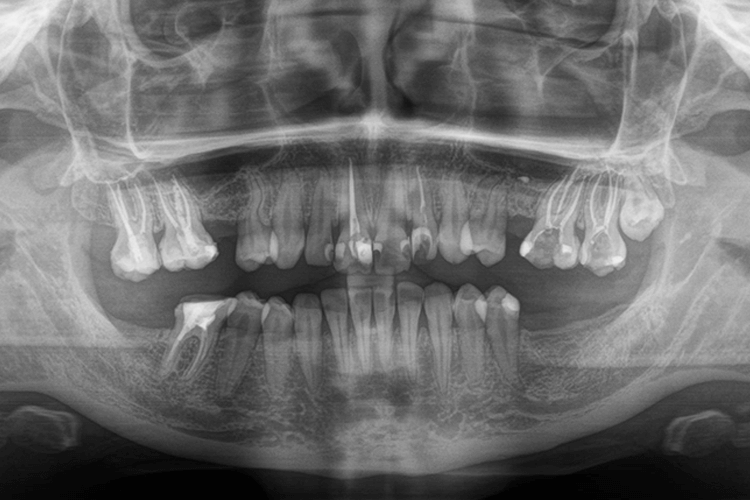
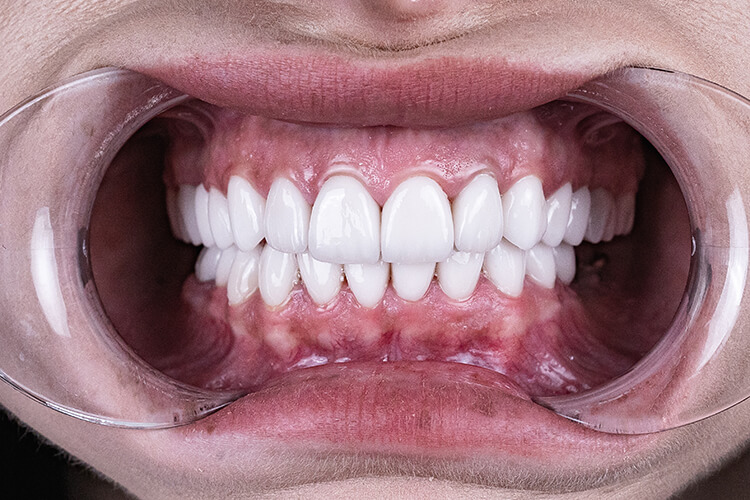
A patient came to our clinic with the following problem: secondary edentulism, with 5 missing teeth. The goal was not only to restore dental function, but also to improve the smile as a whole.
The doctors needed to restore the teeth in the shortest possible time.
Therefore, the doctors — a surgeon, prosthodontist, periodontist, endodontist, and orthodontist — performed examinations, diagnostics, and a joint consultation after receiving the results.
Since the teeth had been lost quite a long time ago (2 years earlier), anatomical changes had occurred in the structure of the jaws, and the antagonists of the missing teeth had moved downward. We suggested returning them to occlusion (bite contact) using a bracket system, but the duration of this treatment did not suit the patient, so we did not develop this treatment plan further. We then suggested depulping the upper teeth on both sides and covering them with crowns, that is, correcting the bite using a prosthodontic method.
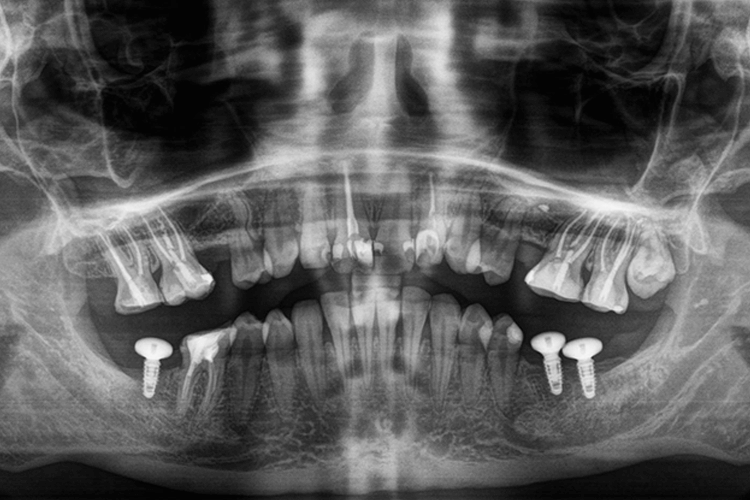
To restore the missing teeth in the lower jaw, we suggested placing dental implants (3 units), followed by ceramic crowns on them, while the missing teeth in the upper jaw would be restored with bridge-like structures supported by the adjacent teeth. The treatment plan was agreed upon, but during the process, after the dental implants were placed, the patient asked the doctor to install dental veneers. Below, we describe all stages of the treatment.
STAGE 1
Examination and diagnostics
Several specialists from different fields examined the oral cavity. They performed 3D diagnostics and identified the existing problems.
STAGE 2
Creating the treatment plan
Two ways to solve the patient's clinical problem were identified, and she was informed in detail about all stages, timelines, and the cost of treatment. The faster treatment plan was chosen.
STAGE 3
Endodontic treatment
Professional oral hygiene was performed in one visit, after which the endodontist depulped the teeth for further prosthetic treatment.
STAGE 4
Implant placement
The oral surgeon and implantologist performed a two-stage dental implant placement procedure. Three dental implants were placed.
STAGE 5
Scanning and modeling
After implant placement, the patient wanted to have dental veneers placed, so the doctor scheduled a clinic visit for planning and digital scanning of the jaws. The future veneers were modeled digitally, the shape and shade of the teeth were determined, and a template was made for the initial trial fitting.

STAGE 6
Trial fitting of the future veneers
A composite material was transferred into the oral cavity using a previously made mock-up model. The shape and shade of the teeth were finalized with the patient.
STAGE 7
Preparing the teeth for prosthetic treatment
The endodontically treated teeth were prepared for dental crowns and bridges, and the partially healthy teeth were prepared for veneer fixation.
STAGE 8
Fabrication of veneers, dental crowns, and bridges
The digital impressions of the jaws were sent to the laboratory to fabricate all-ceramic dental restorations on a milling machine. After the machine stage of fabrication was completed, the dental technician applied special stains and glaze to give the teeth an even more natural appearance.
STAGE 9
Fixation of veneers, dental crowns, and bridges
All finished dental restorations were transferred into the oral cavity and fixed with dental cement. 1.5 months after implant placement, dental crowns were placed on the implants.
SUMMARY
Our specialists initially estimated the full treatment plan would take 3 months, but thanks to effective teamwork and the patient's high level of responsibility, we were able to complete everything in 1 month, with the patient visiting the clinic 5 times.