Implant placement and implant-supported prosthetics

Maksym Makarenko

Максим Макаренко Specializes in: surgery, implant placement, and prosthetics

A patient came to our clinic on a recommendation with a request to replace bridge prostheses on the upper jaw on both sides and restore the front teeth. Previously, bridge prostheses ("bridges") had been placed where teeth were missing, but they were damaged because the patient is actively involved in boxing, and such prostheses are not designed for constant excessive loads. The teeth needed to be restored using a more reliable method, taking into account our patient’s hobby.

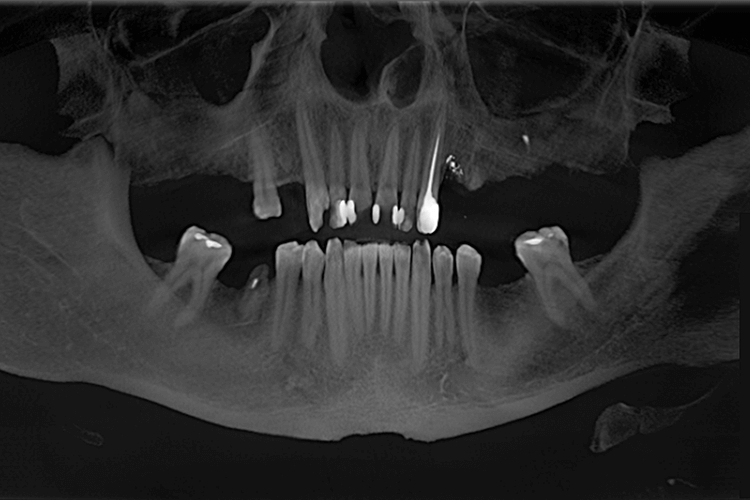
During diagnostics, deep caries of the front teeth was detected, along with slight wear of the lower front teeth due to malocclusion, and the lower sixth teeth were missing on both sides.The roots of the teeth that had previously served as supports for bridges on the upper jaw were destroyed and had to be removed; cystogranulomas were also found in the area of these teeth.

We proposed the following treatment plan:
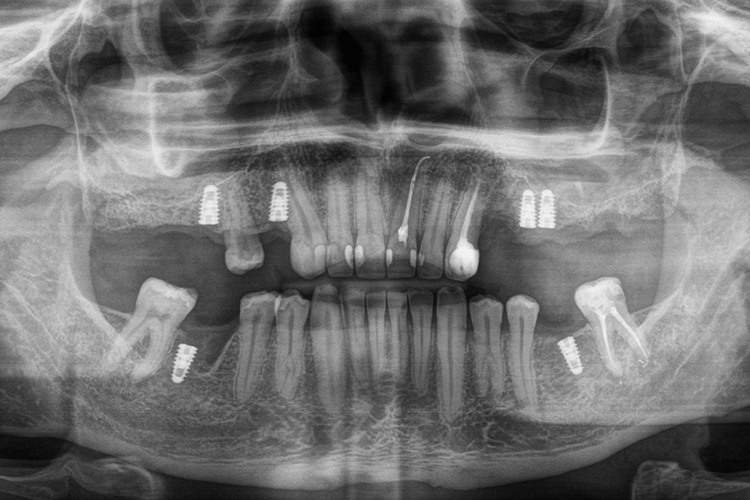
Treatment of caries and aesthetic restoration of the front teeth. Removal of the destroyed teeth and placement of 4 implants in the upper jaw and 2 implants in the lower jaw at the sites of the missing teeth, followed by restoration of the missing teeth with E-max lithium disilicate crowns. Both the implants and the upper front teeth would be restored with these crowns, while the lower front teeth would be left unchanged because they were completely healthy.

STAGE 1

Examination and diagnostics

The doctor examined the patient, performed CT diagnostics, and created a treatment plan. After agreeing on the treatment plan with the patient, treatment began.
STAGE 2

Caries treatment

Caries in the front teeth was treated, and complete oral cavity sanitation was performed before the surgical procedure. Six front teeth were restored with composite materials in one visit together with the caries treatment. This allowed the patient to feel comfortable socially after treatment. The incisal edge of the lower front teeth, which had been slightly damaged due to overload, was also polished.

STAGE 3

Implant placement

The destroyed tooth roots in the upper jaw were removed. Six implants were placed immediately after tooth extraction. Local anesthesia was used. After the surgery, the patient was released for 3 months.
STAGE 4

Scanning and modeling

Digital scans of both jaws and the bite were taken. These impressions would be the basis for the mock-up model, with which the patient would try on a “draft” version of the dental crowns. The patient’s future smile was modeled, and a model was produced based on this design.
STAGE 5

Try-in of the future teeth

Composite material was transferred into the oral cavity using the mock-up model. Based on the resulting shape and tooth shade, the aesthetic parameters of the future prostheses were assessed. The shape and shade were approved. Since the patient did not request any significant corrections, tooth preparation for permanent prosthetics was started.
STAGE 6

Milling and prosthetic restoration

Ceramic E-max (lithium disilicate) prosthetic restorations were fabricated on a specialized milling machine. Prosthetic restoration of the entire upper jaw and the posterior teeth of the lower jaw was performed with E-max crowns. The finished work was delivered to the patient.
SUMMARY

All treatment lasted 3.5 months. After treatment was completed, we provided recommendations on caring for the dental prostheses and implants and recorded a great video of the entire treatment journey, which can be viewed on our YouTube channel.

Schedule a consultation with a dentist